
Locs carry their own shape, texture, and personality. A low taper fade does not compete with that. It simply cleans up the edges around the locs so the whole style looks intentional instead of overgrown. The fade stays low, near the ears and neckline, while the locs keep their length and fullness on top.
That balance is why this combination works so well. A high fade can pull attention away from the locs and make the top look disconnected. A low taper frames the locs, keeps the hairline tidy, and still lets the style read as full and natural.
Why a Low Taper Suits Locs
Locs are a long-term style. You grow them, maintain them, and shape them over months and years. A low taper respects that timeline. It only touches the short hair at the perimeter, so it never shortens the locs themselves.
It also solves the most common problem with locs: the fuzzy, uneven edge that appears between appointments. As new growth comes in around the temples and nape, the outline softens. A low taper restores that outline in one short barber visit, without disturbing the locs.
This pairing works for most loc types, including traditional locs, freeform locs, and locs started with two-strand twists. If your hair is coily or textured, our guide to a low taper fade for coily hair explains how barbers handle length and shape for tight curl patterns, and the low taper fade for Afro hair guide covers shaping and edge control in more detail.
The Perimeter: Three Zones Your Barber Cleans Up
A low taper with locs is really about three small zones. Knowing them helps you explain exactly what you want.
1. Temples and sideburns
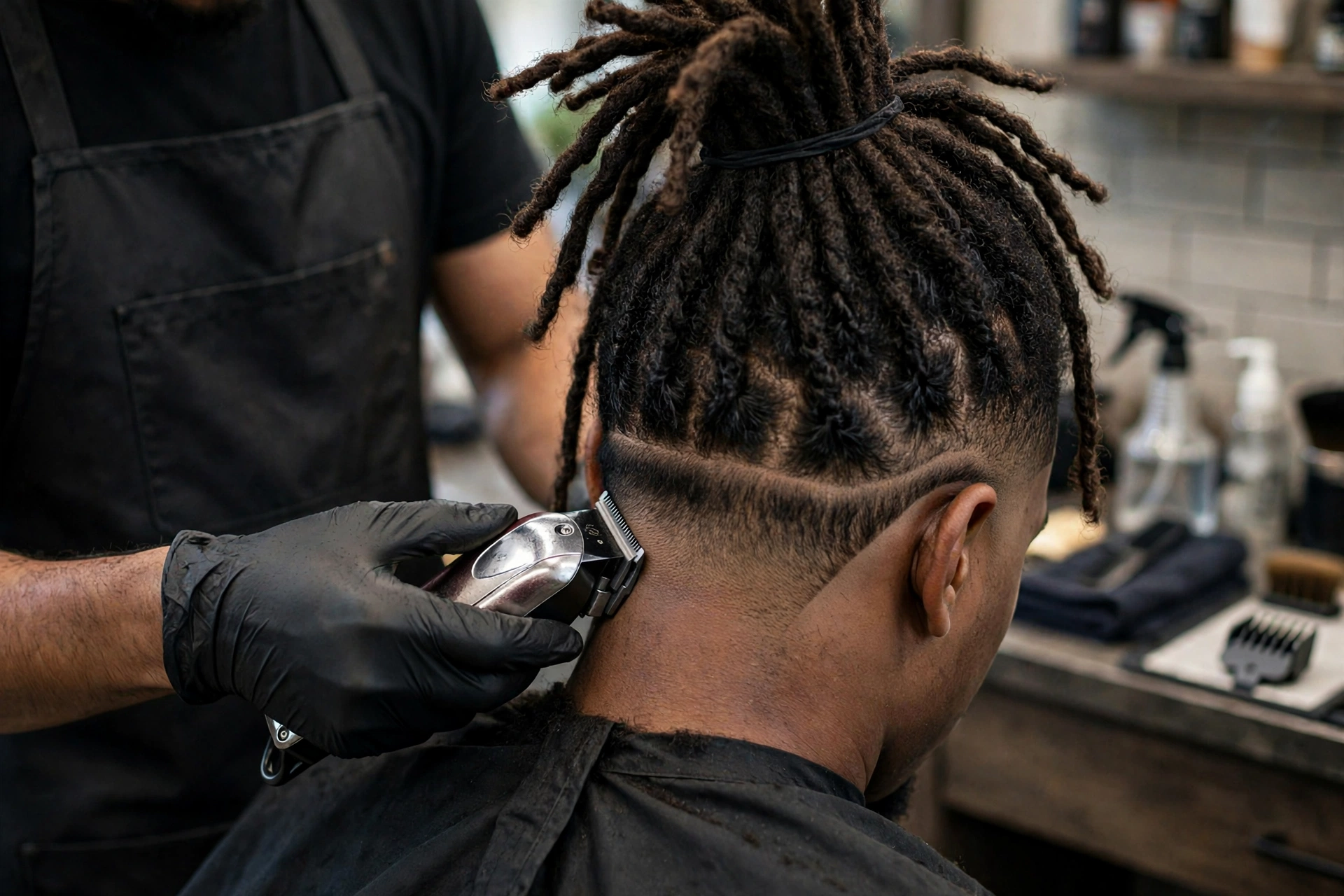
The taper starts just above the ear and blends down toward the sideburn. Ask your barber to keep it low and soft, not pushed high up the side of the head. On locs, a taper that climbs too high can cut into the locs at the hairline and leave a gap.
2. Around the ears
This is where the clean look comes from. The hair behind and around the ear is tapered short so the locs sit neatly above it. If you wear your locs tied up, this zone matters even more, because it is fully visible.
3. The neckline
The nape can be tapered to a natural finish or shaped into a clean, rounded or slightly squared outline. A natural finish grows out more gracefully. A shaped neckline looks sharper but needs more frequent touch-ups.
What to Ask Your Barber: An Exact Script
Use this script at your next visit, and adjust the last line to your preference:
“I have locs and I want a low taper fade, just around the perimeter. Please keep the fade low around the ears and neckline, blend the sideburns softly, and do not cut into the locs. For the neckline, I want a [natural / clean rounded] finish. Can you tie the locs back first so you can see the outline clearly?”
Two extra points are worth saying out loud. First, ask the barber to secure the locs away from the clippers before starting, so no loc is accidentally clipped. Second, if you have a line-up, say whether you want it crisp or natural. A crisp line-up looks sharp but can thin a fragile hairline if it is pushed back at every visit.
Bring a reference photo of a low taper with locs, not just any fade. Taper height is the detail most often misunderstood, and a photo removes the guesswork.
Locs Lengths and Styles That Pair With a Taper
Short locs, often called starter or short locs, look especially clean with a low taper. The contrast between the textured top and the faded sides gives a short style structure it would otherwise lack.
Medium-length locs are the most versatile. Wear them down, tied back, or in a low ponytail, and the taper still shows. This is also the length where a taper makes the biggest difference, because medium locs can otherwise look heavy around the ears.
Long locs benefit too, but the effect is subtler. The taper is mostly visible when the locs are pulled up or back. If you usually wear long locs loose, think of the taper as a neatness detail rather than the main feature. A similar idea applies to other long styles — see our guide to a low taper fade with long hair on top for how length and a low fade work together.
Freeform locs need a gentler hand. Tell your barber to taper only the loose hair at the perimeter and to leave the formed locs alone. If your barber is unsure about freeform work, a barber who regularly cuts locs is a safer choice than a general fade specialist.
Upkeep: Two Schedules, Not One
Locs and tapers run on different clocks, and that is normal.
Refresh the taper every 2 to 3 weeks. That keeps the outline crisp without over-cutting. If your hair grows fast, every 2 weeks is better; slower growth can stretch to 3 weeks.
Retwist or maintain the locs every 4 to 8 weeks, depending on your method, hair type, and how neat you like the roots to look. Interlocking usually lasts longer between sessions than palm rolling. Do not retwist too often or too tightly — tension at the roots can cause thinning, especially at the hairline and temples where the taper already draws attention.
Between visits, keep the scalp clean and lightly moisturized. A low taper exposes more scalp than a full head of locs, so dryness and flakes show more easily. A light oil on the scalp and the tapered area, plus a regular wash routine, is usually enough. At night, a satin or silk scarf or durag protects both the locs and the fresh taper edge. If you wear braids as well as locs at different times, our low taper fade with braids guide covers how the same low fade frames braided styles.

Mistakes to Avoid
Do not let the taper creep higher at each visit. A little higher each time turns a low taper into a mid fade within a couple of months, and it can eat into the locs at the sides.
Do not combine a fresh retwist with a very tight line-up on the same day if your hairline is already fragile. Spread the tension out.
Do not try to taper the perimeter yourself with clippers unless you are experienced. The blend line behind the ear is hard to see in a mirror, and one wrong pass creates a line that takes weeks to grow out.
Finally, do not skip the taper for months and then ask for a dramatic clean-up in one visit. A gradual return to the shape looks better and is kinder to the hairline.
FAQ
Q: Will a low taper fade damage my locs? A: No, if the barber only works on the perimeter hair. The risk comes from cutting into the locs or pulling them tight during the cut, so ask the barber to secure them first.
Q: How often should I get the taper touched up? A: Every 2 to 3 weeks for most people. Retwists are less frequent, usually every 4 to 8 weeks, so the two schedules will not always line up.
Q: Can I get a low taper if my locs are still short? A: Yes. Short locs pair very well with a low taper, as long as there is enough loose hair at the sides and nape to blend. Your barber can tell you if your locs are long enough to frame cleanly.
Q: Should the neckline be tapered or blocked? A: A tapered, natural neckline grows out more gracefully. A blocked or shaped neckline looks sharper but needs touch-ups more often. Pick based on how often you visit the barber.
Final Verdict
A low taper fade with locs is a low-risk upgrade with a high payoff. It keeps the perimeter clean, frames the locs, and needs only a short visit every few weeks. Agree on the taper height, protect the locs during the cut, and keep the retwist and taper schedules separate — and the combination will look sharp for months.