
You asked for a low taper fade, but the fade starts way above your ear, climbing up the side of your head like a mid fade you never ordered. Don’t panic. A taper cut too high is one of the most common haircut complaints in American barbershops, and it is far more fixable — and far more temporary — than it feels right now.
This guide covers what happened, what your barber can still fix today, what you will simply have to grow out, and the exact words to use next time so it never happens again.
Why Tapers Get Cut Too High
A taper that lands too high is rarely a sign of a bad barber. It is almost always a communication gap:
- You never said “low” out loud. Plenty of guys ask for “a taper” and assume the barber hears “low taper.” Many barbers default to a mid-height taper because it is what they cut all day. No specified height means you get the house default.
- “Low” means different things to different people. Your idea of low — the fade starting just above the ear — might be your barber’s idea of a mid taper. Without a shared reference point, both of you can walk away confident and still disagree.
- No one marked the starting height. Good barbers point and ask, “You want the taper to start here?” If that check never happened, the height was a guess.
- No reference photo. Photos remove guesswork. A 30-second photo check is the biggest reason some cuts come out exactly right and others miss.
What Your Barber CAN Fix Right Now
If you are still in the chair — or you go back within a day or two — a good barber has several moves. None can put hair back, but they can make the cut look far more intentional:
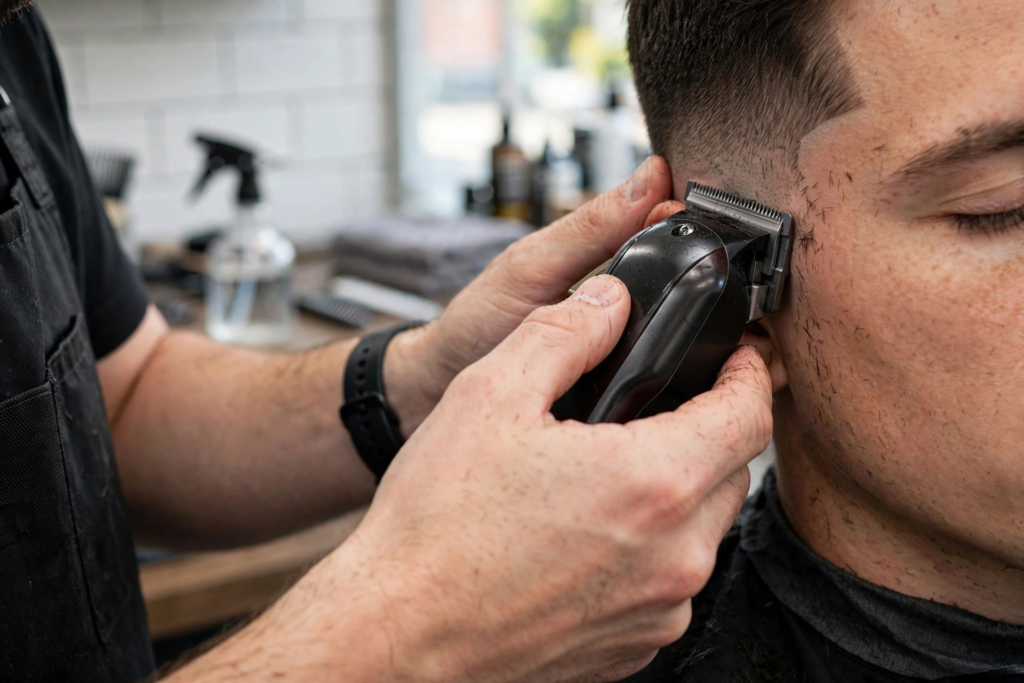
- Soften harsh lines. A too-high taper looks worse when the transition is sharp. Your barber can re-blend it with clipper-over-comb or a half guard (#0.5 or #1.5) for a smooth gradient.
- Even out both sides. One side often sits higher. Matching the two sides instantly makes the cut look deliberate.
- Drop the visible line slightly. Working the #1 or #1.5 guard just below the original line extends the blend downward a fraction, so the fade reads as lower.
- Clean up the neckline and edges. A crisp neckline and sharp lineup make the whole cut look finished — a small fix with an outsized effect.
Be realistic: blending can close roughly half the visual gap.
For your next visit, read our exact script for asking your barber for a low taper fade so the height is never a guess again.
What CAN’T Be Fixed (And How to Survive the Wait)
Here is the hard truth: cut hair cannot be put back. If the taper is simply too high, the only true fix is time.
Side hair grows roughly half an inch per month, so the taper zone usually looks softer after 2 to 3 weeks. By week three, the “too high” feeling is mostly gone.
While you wait, these tricks buy you camouflage:
- Grow the top a little longer. Extra length on top shifts visual weight upward and balances a high taper.
- Use a matte styling product. Matte clay or paste adds texture and fullness up top, distracting from the sides. Skip high-shine gels that slick everything tight.
- Don’t slick the sides back. Brushing the sides flat highlights how high the fade goes. Textured movement on top draws the eye away.
- Wear a hat when it matters. For an interview or a wedding this weekend, a clean cap is a fine short-term strategy.
Most low tapers need a touch-up every 2 to 3 weeks. Our guide on how often to get a low taper fade touched up shows how to time visits so the cut never gets away from you.
The Exact Script for Next Time
Forty seconds of conversation before the clippers turn on prevents this. Say all five:
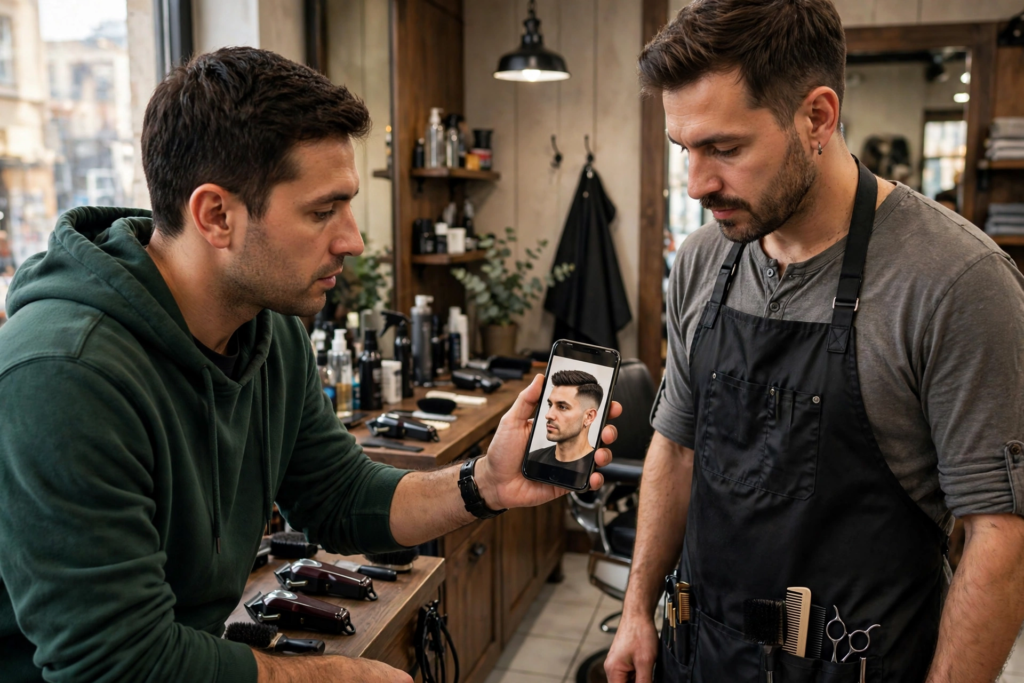
- Say “low” explicitly. “I want a LOW taper fade.” Say it first.
- Point to the starting height. Touch just above your ear: “I want the taper to start right here — just above the ear, not higher.” Pointing beats describing.
- Ask for a height check before the shortest guard. “Before you go to your shortest guard, can you check the height with me?” Any good barber respects it. Knowing what the different guard numbers mean also helps you follow along.
- Bring a reference photo. Save two or three low taper photos on your phone — ideally on hair texture similar to yours — and point at where the taper starts.
- Say what you DON’T want. “Last time it went too high — I don’t want it above my ear.”
Our complete low taper fade guide covers every variation, so you can walk in knowing exactly which one to ask for.
Same Barber or a New One?
It depends on what happened in the chair.
Go back to the same barber when…
- The barber listened and worked carefully, and the height was an honest miscommunication. A returning client is worth more to them than one cut.
- You go back quickly. Many shops will adjust a cut within a few days. Walk in or call, stay polite, and show the issue in natural light: “The taper came out higher than I wanted — can we soften the blend?”
Find a new barber when…
- The barber rushed, didn’t listen, or got defensive. Technique can be taught; listening can’t.
- This is the second or third miss. One miscommunication is normal. A pattern is information.
A quick word on tipping
Tipping 15–20% is standard in US barbershops. If the fix is free, you don’t owe a second full tip — but a few dollars as a goodwill gesture keeps the relationship warm. For a fresh cut at a new shop, tip normally on the full price (typically in the $25–$45 range in most US cities).
Frequently Asked Questions
Can a barber lower a taper that was cut too high?
Not literally — cut hair can’t be put back. But a barber can soften harsh lines, even out both sides, and extend the blend slightly downward, making the taper look lower and more intentional. The rest evens out as it grows.
How long until it grows back to normal?
The taper zone usually looks natural again within 2 to 3 weeks. For the full low taper shape back exactly as you like it, allow one growth cycle plus a cleanup — around 3 to 4 weeks total.
Should I tip if I’m asking for a fix?
If the correction is free, a small tip of a few dollars is a nice gesture, but a second full tip isn’t expected. For a new cut elsewhere, tip the standard 15–20%.
Is it rude to ask for a correction?
No — not if you’re polite and prompt. Barbers expect occasional adjustments. Go back within a few days and give them a chance to make it right. What frustrates barbers isn’t the request — it’s being told weeks later, or being told rudely.