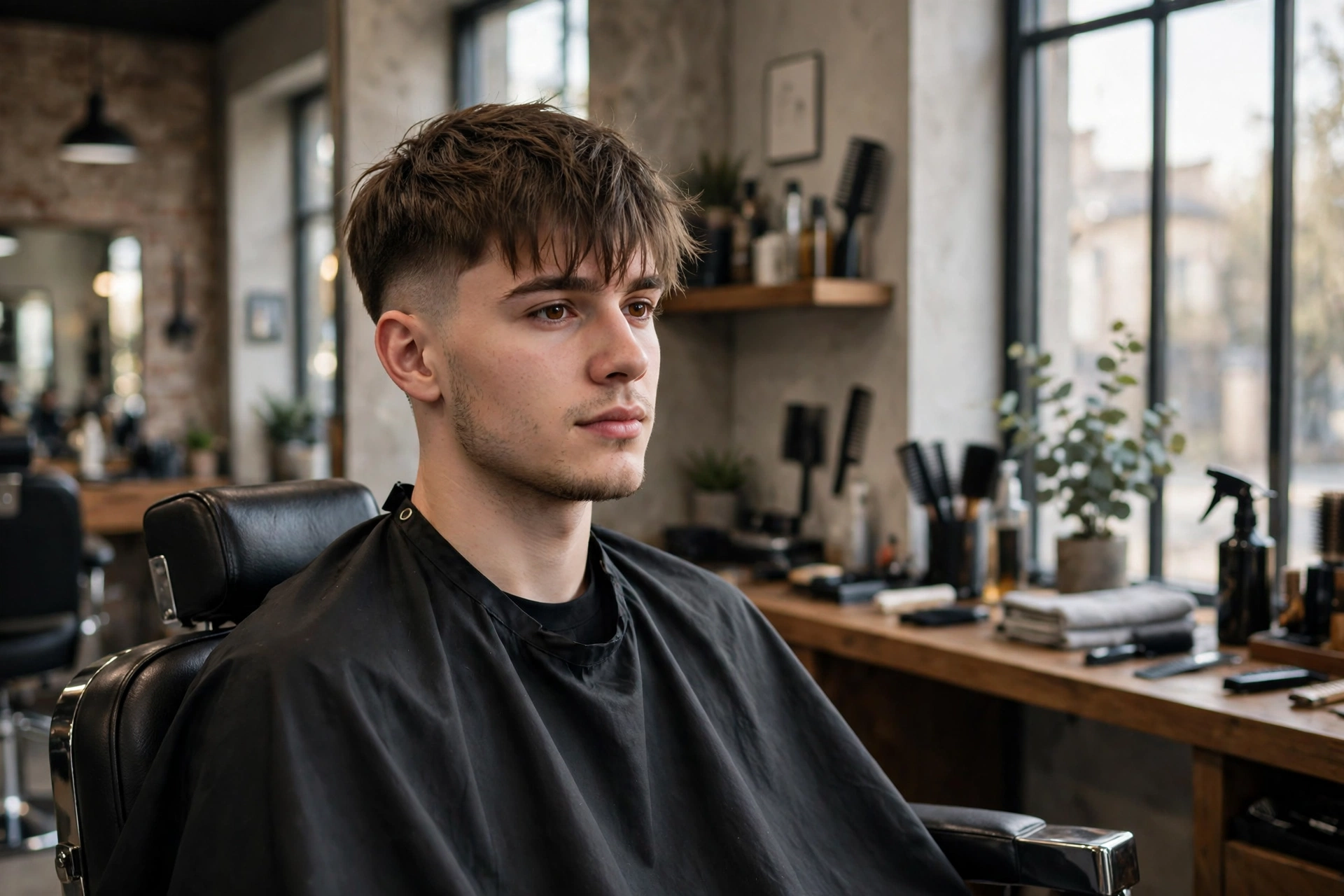
A low taper fade with a textured fringe is one of the most wearable modern haircuts. The sides stay clean and gradual, the top keeps enough length to move, and the front falls forward in soft, broken-up pieces instead of a solid wall of hair. It looks relaxed without looking messy, and it works for the office, the gym, and a night out with almost no change in routine.
The cut gets its name from two parts. The “low taper fade” keeps the shortest hair down near the ears, sideburns, and neckline, blending upward so there is no harsh line. The “textured fringe” is the front section, cut with point-cutting or texturizing scissors so the ends are uneven and piecey rather than blunt. Together, they give you structure on the sides and movement on top.
Who the Textured Fringe Suits Best
This style is a strong choice if you have straight, wavy, or loosely curly hair and want a cut that hides a high forehead or softens a strong hairline. Because the hair falls forward, it covers the forehead instead of exposing it, which also helps if your hairline is starting to recede at the temples.
Face shape matters less here than with many fades, but a few notes help. Round faces benefit from a little extra height at the front, which lengthens the face. Long faces should keep the fringe a touch longer and flatter, so it does not add more vertical length. Square faces look great with a slightly messy, broken-up fringe, since the softness balances a strong jaw. If you are unsure which version fits you, bring reference photos and ask your barber to adjust the fringe length to your forehead, not to a photo of someone else.
What to Ask Your Barber For
Clear wording makes the difference between a textured fringe and an accidental bowl cut. Use this script:
“I want a low taper fade on the sides and back, fading out just above the ears. Keep the top around 2 to 3 inches, longer at the front. For the fringe, I want it textured, not blunt — point-cut the ends so it falls forward in separate pieces, ending just above my eyebrows.”
Mention the guard length if you want the taper tighter or softer. A #1 guard leaves a short, clean blend, while a #2 guard keeps a little more shadow. If you need help with the wording, our guide to the exact script for asking your barber for a low taper fade walks through the full conversation, and our guard numbers explainer breaks down what each guard length actually looks like.
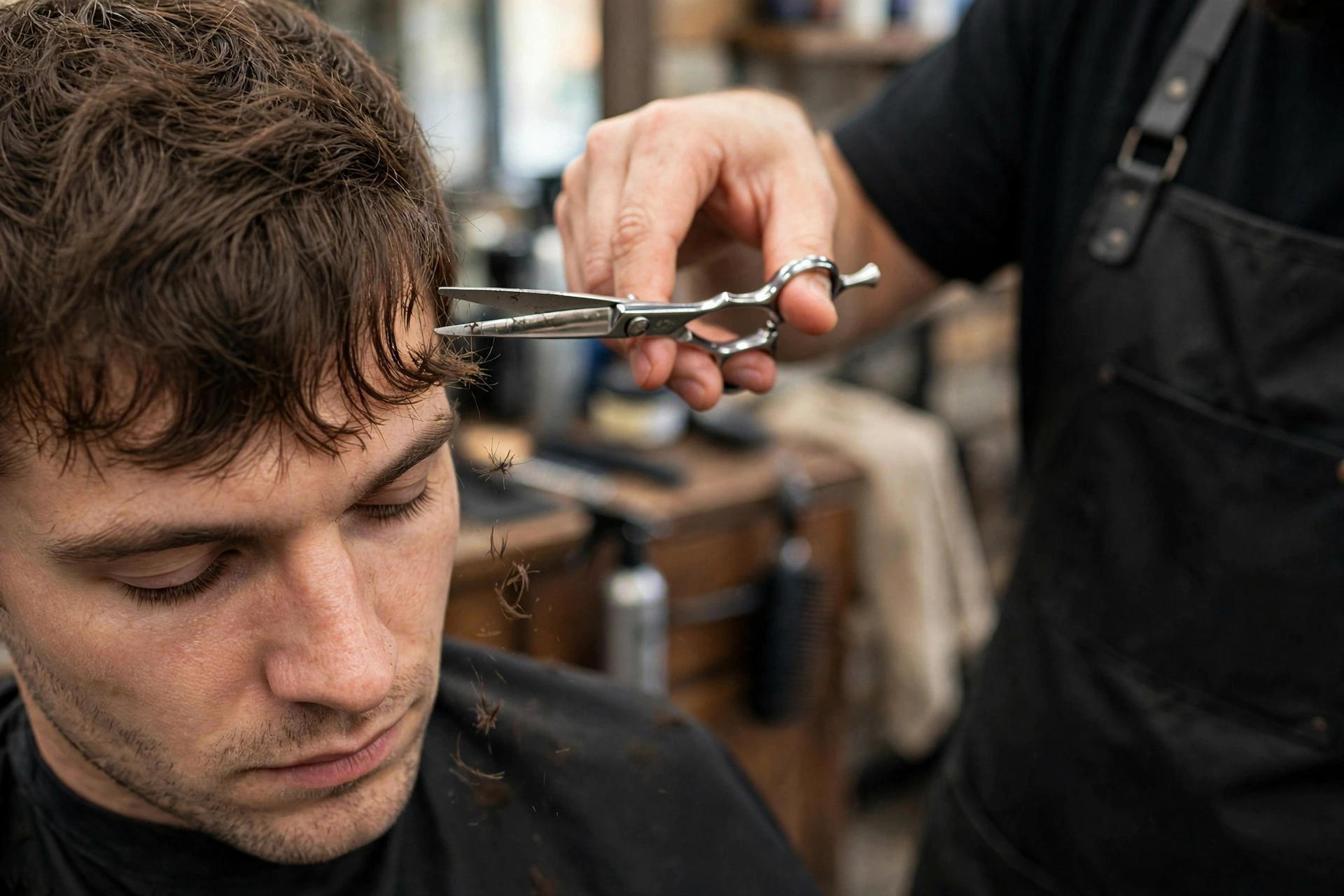
How to Style It: The 5-Minute Routine
Start with damp hair. Towel-dry until it is no longer dripping, then work a pea-sized amount of matte paste or clay through the top, starting at the back and pushing forward. Use your fingers, not a comb — fingers keep the pieces separate, while a comb flattens the texture.
Blow-dry on low or medium heat, directing the air forward and slightly down. Lift the roots at the front with your fingers if you want extra volume. Once the hair is mostly dry, pinch a few fringe sections together to define the pieces, then stop. Overworking it is the most common mistake; the style should look like it happened naturally, not like it was sculpted.
For a messier finish, skip the blow dryer and let the hair air-dry after applying a sea-salt spray.

Styling by Hair Type
Straight hair: Straight hair needs help holding texture. Use a sea-salt spray or volumizing spray on damp hair, blow-dry forward against the direction the hair naturally falls, then finish with matte paste or texture powder. Apply product through the whole top, not just the fringe, or the front will look disconnected from the rest.
Wavy hair: Wavy hair is the easiest match for this cut. Apply a lightweight curl cream or sea-salt spray, scrunch gently instead of brushing, and let the waves form the texture on their own. Air-dry or use a diffuser on low heat, then separate the fringe pieces with your fingers. A small amount of flexible paste is enough if you need extra hold.
Curly hair: If your curls are tight, a textured fringe can still work, but the front needs more length so the curls can fall forward instead of springing up. Use leave-in conditioner or curl cream on damp hair, define the curls in small sections, and avoid touching them while they dry. Our guide to what to tell your barber if you have curly hair and want a low taper covers the length and technique details worth agreeing on before the clippers come out.
Upkeep: How Often to Trim
A low taper fade with a textured fringe holds its shape for about 3 to 4 weeks. The taper grows out first — the clean blend around the ears softens — while the fringe usually stays wearable a little longer. Book a trim every 3 weeks if you like the fade razor-sharp, or every 4 weeks if you are happy with a slightly softer grow-out.
Between cuts, keep the neckline tidy with a trimmer if you are comfortable doing it, but leave the fringe alone. Trimming the fringe yourself almost always removes too much length or creates a blunt line, which is exactly what the textured cut avoids. A typical US barbershop visit for this cut runs roughly $25 to $50 depending on the city and the shop, with a tip of 15 to 20 percent being standard.
Mistakes That Ruin the Look
Too much product is the biggest one. Heavy gel or a large amount of pomade flattens the texture and turns the fringe into a solid sheet. Use less than you think you need, then add more only if the style falls flat.
A blunt fringe is the second mistake. If your barber cuts the front straight across with no texturizing, ask for point-cutting at your next visit, or find a barber who regularly cuts textured styles. And do not pair this cut with a high, skin-tight fade unless you want a sharp contrast — the low taper is what keeps the whole style soft and balanced. For more inspiration, browse our 35 low taper fade looks to compare fringe lengths and finishes before your appointment.
FAQ
Q: Does a textured fringe work with thin hair?
A: Yes, with the right length. Keep the fringe slightly shorter and use texture powder or a light volumizing spray, which adds grip without weight. Avoid heavy products that flatten fine hair.
Q: Can I wear a textured fringe to a professional job?
A: Yes. Keep the fringe neat, the taper clean, and the finish matte rather than spiky. It reads as a modern, well-groomed cut, not a rebellious one.
Q: How long should the top be for a textured fringe?
A: About 2 to 3 inches works for most hair types, with the front slightly longer than the crown. Shorter than that, and there is not enough length to create visible texture.
Q: Will the fringe fall into my eyes?
A: Not if it is cut correctly. The fringe should end just above the eyebrows. If it keeps falling forward, ask your barber to take a little length off the front, not to thin the whole top.