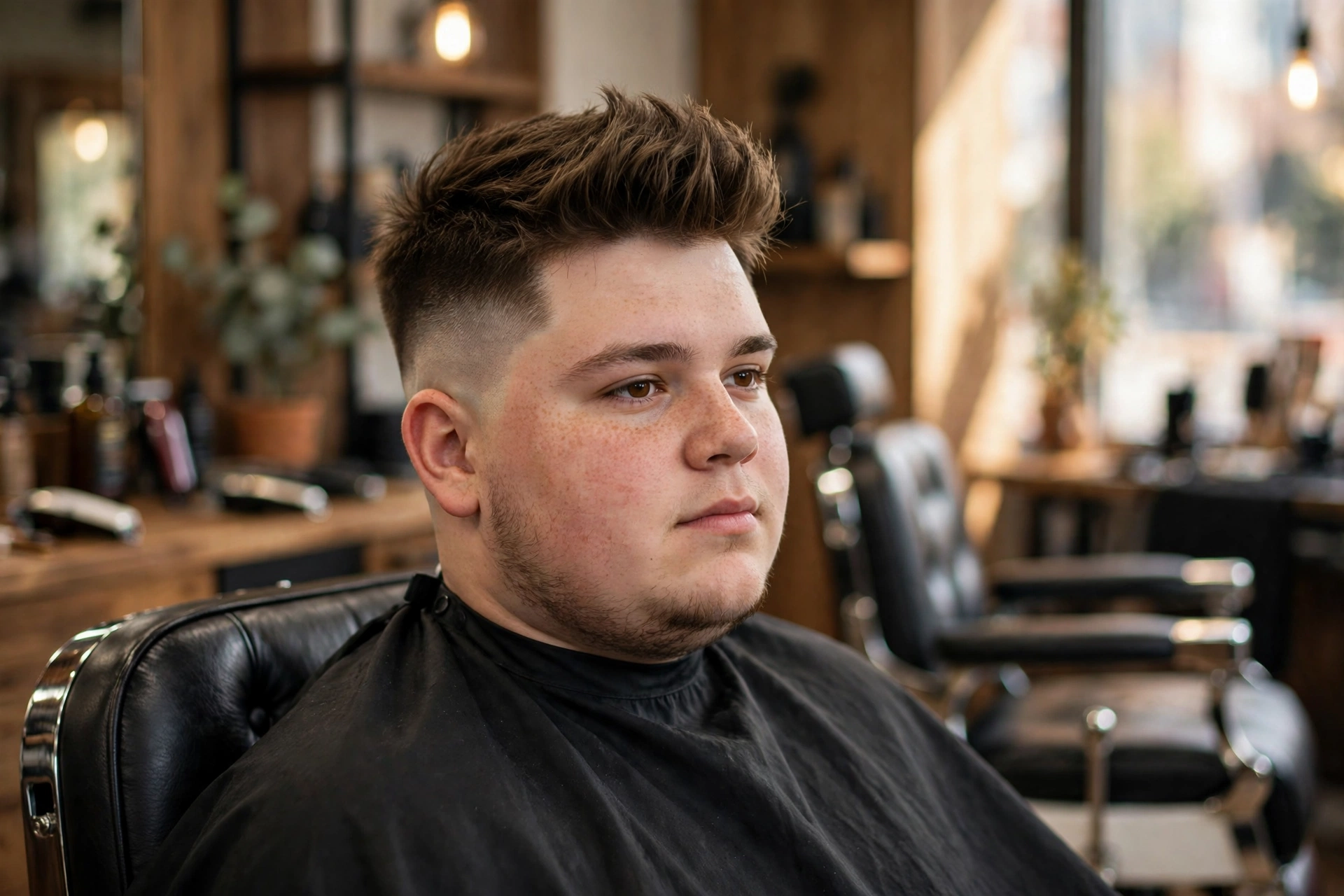
A round face and a low taper fade are a good match — but only when the cut is built the right way. A round face is about as wide as it is long, with full cheeks and a soft jawline. The goal is not to “fix” your face. It is to add a little height on top and keep the sides tight, so the whole shape looks longer and more balanced.
The low taper fade does the second half of that job by itself. The fade starts just above the ear and blends down toward the neckline, so the sides stay clean without adding width at the cheekbones. The top is where you add the height. Get that balance right and the cut looks sharp in the office, at the gym, and in photos.
How to tell if you have a round face
Stand in front of a mirror with your hair pulled back. A round face usually has:
- Cheekbones and jawline at roughly the same width
- A jawline that curves instead of forming a sharp angle
- Face length and width that are close to equal
- Full cheeks with no strong corners
If your face is noticeably longer than it is wide, you probably have an oval or long face instead, and the rules change — height on top would only stretch things further. If you are unsure, ask your barber. Barbers check face shape every day, and a good one will tell you honestly.
Why a low taper fade works for a round face
Most fades slim the sides, but the low taper does it quietly. Because the blend starts low, near the ears, it keeps the sides neat without the strong contrast of a high fade. That matters for a round face: a high fade can work too, but it is a bolder look, and it shows more scalp and head shape.
With a low taper, the trick is the top. Two to three inches of textured length, styled upward, pulls the eye up and makes the face look longer. Keep the sides tight and the top tall, and the proportions shift in your favor. A flat top with wide sides does the opposite — it makes the face look wider, which is exactly what you want to avoid.
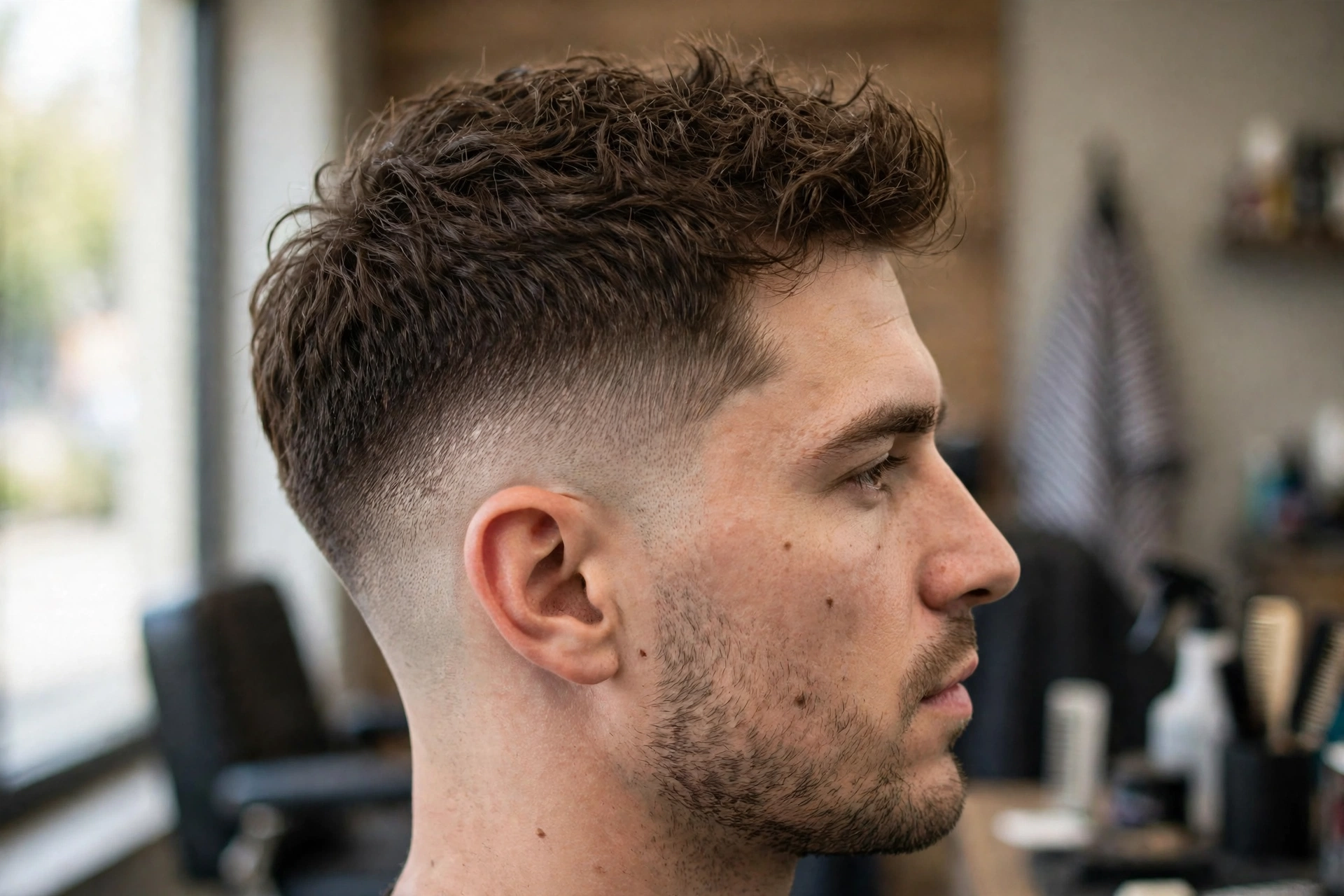
The 5 best low taper fade styles for a round face
1. Low taper fade with a quiff
The quiff is the strongest choice for a round face. The front sweeps up and back, adding 2 to 3 inches of visible height. Ask for a low taper on the sides and 3 to 4 inches on top, then style it with a matte clay and a blow dryer. Our full guide to a low taper fade with a quiff covers the styling steps in detail.
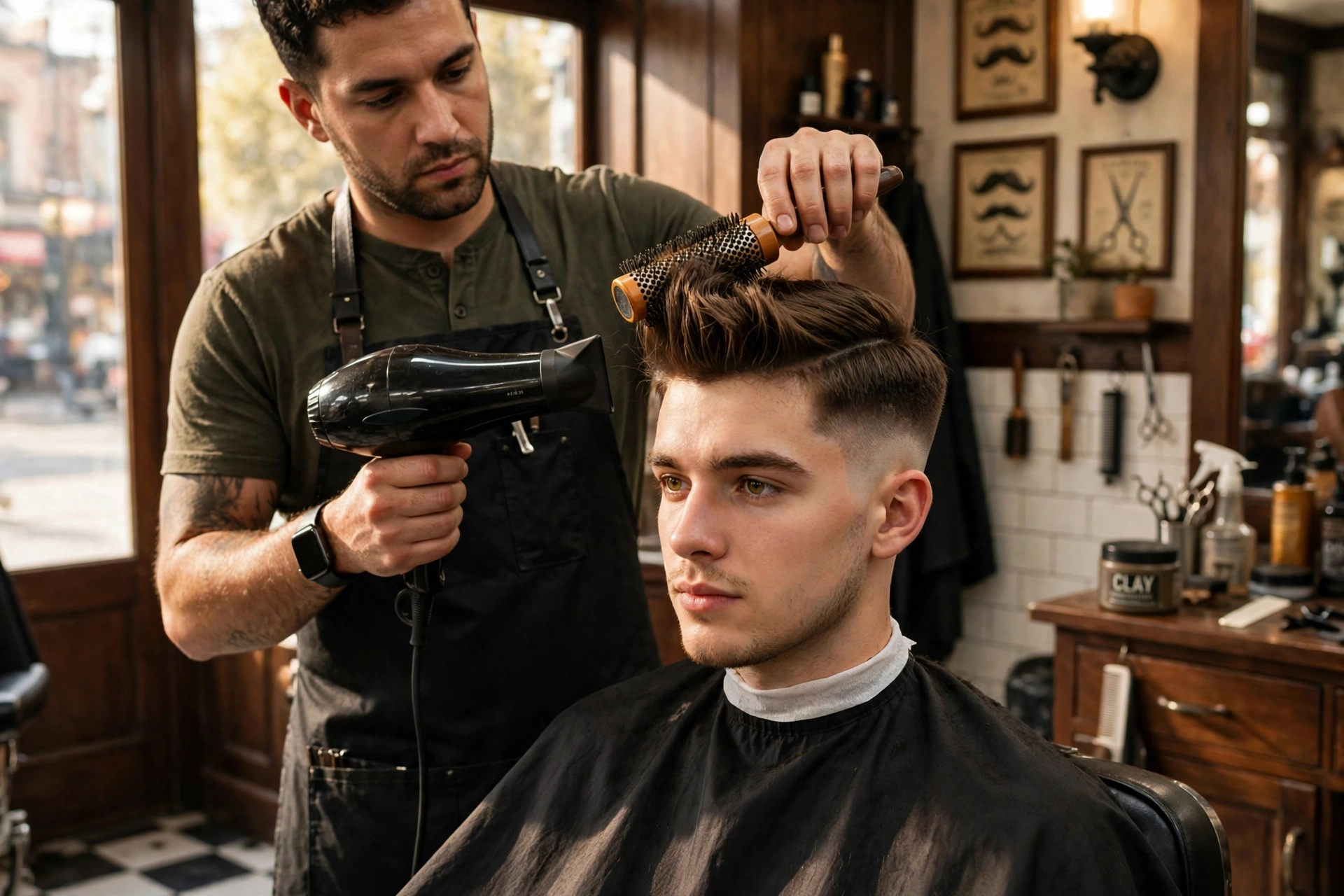
2. Low taper fade with a pompadour
The pompadour is the classic version of the same idea: volume swept up and back from the forehead. It needs a little more length on top — around 4 inches — and a medium-hold pomade. It suits guys who like a polished, put-together look. See how the low taper fade pompadour is cut and styled.
3. Textured crop with height
If you do not want a long styling routine, a textured crop is the low-effort answer. Ask for choppy, piece-y texture on top with 2 to 3 inches of length, and a low taper on the sides. Rub a small amount of matte paste through damp hair and push it upward with your fingers. It takes about a minute and still adds the height a round face needs.
4. Low taper fade with a side part
A side part adds an angle to a round face. The part line breaks up the symmetry and draws the eye across the head instead of around it. Ask for 3 to 4 inches on top, a low taper on the sides, and a part on your natural side. A low taper fade with a comb over is the neater, more formal version of the same idea.
5. Slicked back with volume
For thicker hair, a slicked-back top with a low taper keeps everything controlled while still adding height at the front. Use a medium-hold cream, comb the hair back and slightly up, and let the taper keep the sides clean. It works best when the front has enough length to sit up rather than lying flat.
What to ask your barber: the exact script
Walk in with clear words. Try this:
“I have a round face, so I want height on top and tight sides. Low taper fade starting just above the ear, 3 inches on top with texture, styled up. No bulk at the sides, and keep the taper low — not a skin fade.”
Bring a reference photo too. Photos remove guesswork, and a barber can point at the photo and tell you what will and will not work with your hair. If your hair is very thick, very fine, or curly, say so up front — the same style needs different handling for each hair type.
Styles to avoid with a round face
- Bowl cuts and mushroom tops. Volume at the ears widens the face.
- Blunt, straight-across fringes. A hard horizontal line across the forehead makes the face look shorter and wider.
- Flat tops with no height. If the top lies flat, the low taper alone cannot lengthen the face.
- Center parts with long, straight sides. Curtain-style middle parts add width at the cheekbones on a round face.
- Heavy volume at the temples. Keep the sides clean; the height belongs on top, not at the sides.
Styling and upkeep
A low taper fade for a round face is easy to maintain. Book a touch-up every 2 to 3 weeks to keep the taper crisp — once the sides grow out, the slimming effect fades with them. At home, a matte clay or medium-hold cream and a blow dryer are all you need for the quiff or pompadour styles. Wash with shampoo 2 to 3 times a week, and use conditioner so the top stays soft enough to style upward instead of falling flat.
If you are still choosing between fade heights, our comparison of the low taper fade vs mid taper fade explains when to go lower and when to go higher.
FAQ
Does a low taper fade suit a round face?
Yes. The low taper keeps the sides tight without adding width, and when you pair it with 2 to 3 inches of height on top, the face looks longer and more balanced. The top is what does the slimming — the taper just keeps the sides out of the way.
How long should the top be for a round face?
About 2 to 4 inches, depending on the style. A textured crop works at 2 to 3 inches, while a quiff or pompadour needs 3 to 4 inches to hold its height. Shorter than 2 inches on top leaves nothing to lift, so the face keeps its round look.
Should I get a low taper or a high taper for a round face?
Both can work. A low taper is the safer, more professional choice, and it suits most workplaces. A high taper removes more width from the sides and creates stronger contrast, which can slim the face even more — but it is bolder and shows more scalp. If you are unsure, start low and go higher next visit.
What should I avoid asking for with a round face?
Avoid volume at the sides, blunt straight fringes, and flat tops. Ask for height on top, texture, and tight sides instead — and tell your barber you have a round face so the cut is shaped around it.