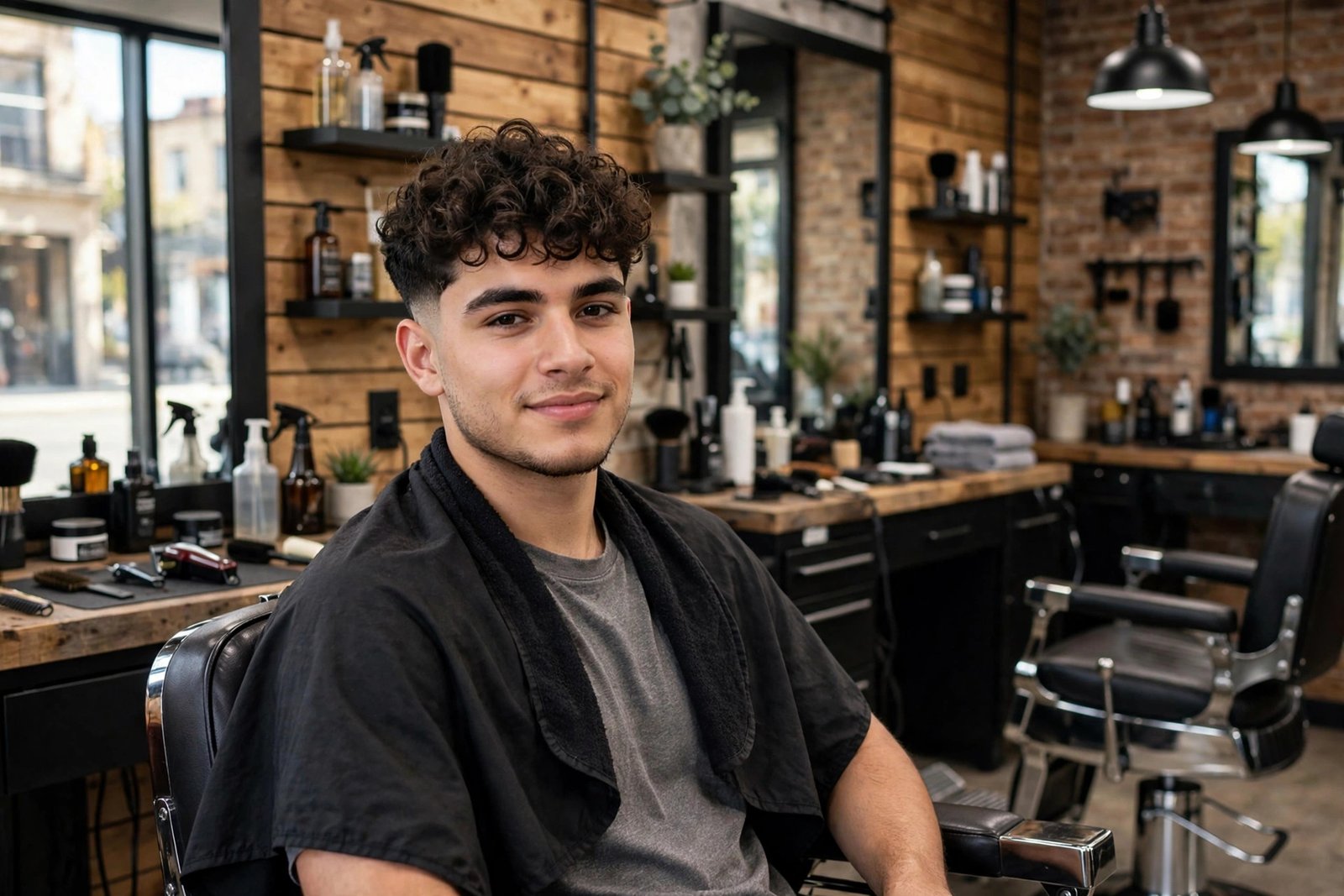
Curly hair changes everything about a haircut conversation. Your curls shrink when they dry, each curl pattern reacts differently to cutting, and one wrong guard can turn your taper into a hard line you did not ask for. That is why asking for a low taper fade with curly hair takes different wording than straight hair.
This guide gives you the exact words to use, the phrases to avoid, and the curly-specific details that keep your cut safe. If you want the general version of this script first, check out our exact script for any hair type.
The Exact Script: What to Say
When you sit in the chair, say something like this. Keep your voice calm and clear. You are giving your barber a plan, not hoping for the best.
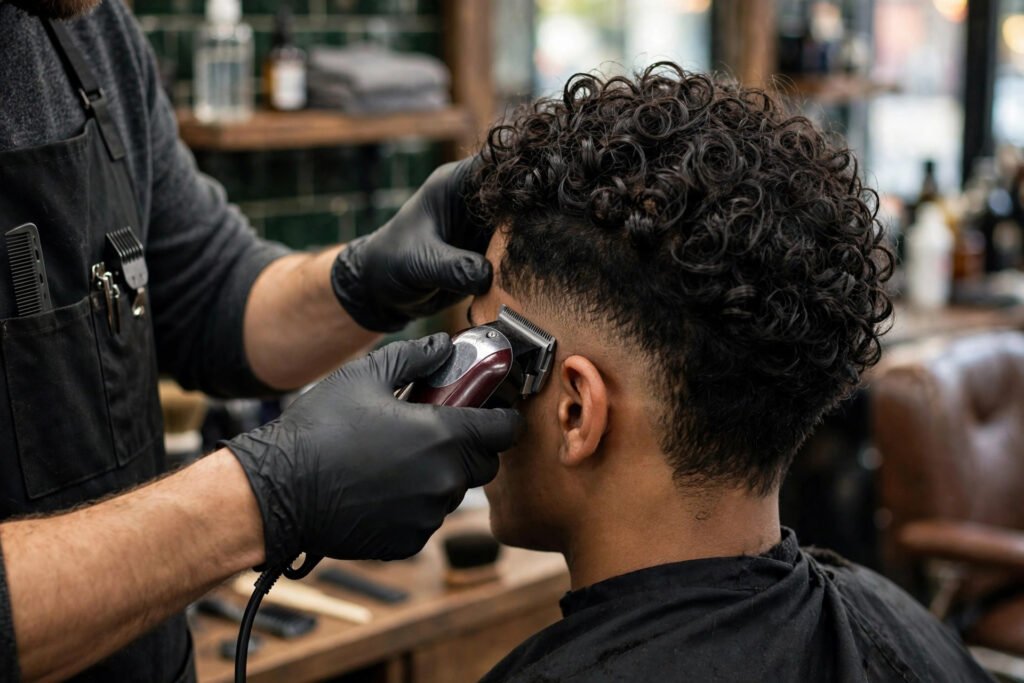
I have curly hair and I want a low taper fade. The taper should start just above my ears and follow my neckline low — keep the fade low, not mid. At the lowest point, I want a number one or number two guard, then blend up from there. On top, I want to keep [X inches — state the DRY length] of curl when it’s dry. My hair shrinks a lot, so please don’t cut to the length it looks like when it’s wet. Keep my natural hairline — don’t push it back. And I’d like a light line-up, but keep it natural, not a hard edge.
That script covers the four things your barber needs most: how low the taper goes, the guard numbers, the dry length on top, and what to do with your hairline. The low taper fade complete guide breaks down the whole style if you want to understand it before your appointment.
What NOT to Say
These vague phrases are how bad cuts happen. Avoid all of them:
- “Same as last time” — only works with the same barber. A new barber has no idea what “last time” looked like. Use the full script instead.
- “Just a low fade” — this says nothing about guard numbers or how high the blend goes. You could end up with a mid fade or sides shorter than you wanted.
- “Make it neat” — “neat” means something different to every barber. One person’s neat is another person’s way-too-short.
- “Do what you think is best” — only say this with a barber who knows your hair well. With curly hair and a new barber, this is a gamble.
Knowing what you do not want matters as much as knowing what you want. A taper and a fade are different cuts, so naming the right one — taper — keeps the sides natural instead of skin-close.
Curly-Specific Details to Mention
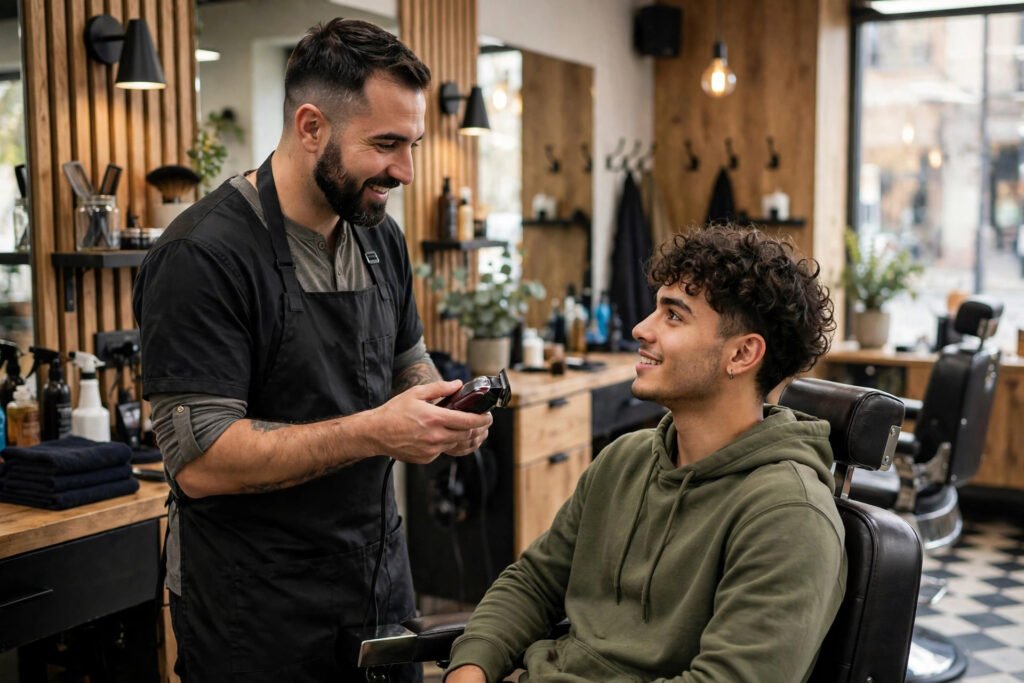
These small details make a big difference for curly hair. Bring them up before the clippers start:
- Dry vs. damp cut: Ask whether your barber cuts curly hair dry or damp. A dry cut (or cutting curls one by one) is usually safer because the barber can see the real length. If your barber prefers working on damp hair, remind them to leave extra length for shrinkage — curly hair shrinks about 30–50% from wet to dry.
- Mention your curl type: Say whether your curls are loose waves, tight coils, or somewhere in between. A quick “my curls are pretty tight, so they spring up a lot” helps the barber plan.
- Ask them to cut conservatively: Tell your barber, “If you’re unsure, take less off — I can always come back for more.” You cannot glue hair back on, but a second pass is easy.
- Bring reference photos: Show a front, side, and back photo of the exact low taper you want. Photos of people with a similar curl type work best. Words plus pictures leave nothing to guess.
Also confirm the taper height. A low taper stays near the ears and neckline, while higher fades move up fast. This low vs. mid vs. high fade comparison shows exactly where each one sits, which helps if your barber asks which level you mean.
Quick Styling Recap
Once you leave the chair with a fresh taper, keeping the curls on top healthy is simple:
- Wash with a sulfate-free shampoo so your curls keep their natural oils.
- Work a curl cream or leave-in conditioner through damp hair to define the curls.
- Use your fingers, not a brush — brushing breaks up curl patterns and creates frizz.
- Book touch-ups every 2–3 weeks to keep the taper clean while the top grows.
FAQ
Should curly hair be cut dry or wet for a taper?
Dry is usually safer for the top. When curls are wet, they look much longer than they really are, and a barber who cuts to the wet length will cut off too much. The tapered sides are typically done with clippers on dry hair anyway, so ask for the top to be checked and finished dry.
What if my barber doesn’t do curly hair?
Ask directly before you sit down: “Do you cut curly hair often?” If the answer is hesitant, find a different barber — ideally one who shows curly cuts in their work. A barber who rarely handles curls is more likely to cut too short or blend unevenly. Many barbers list curly hair as a specialty on their booking page or social profiles.
Can I say guard numbers if my barber uses scissors on top?
Yes. Guard numbers apply to the tapered sides, which are almost always done with clippers even when the top is cut with scissors. Give your barber the guards for the sides (#1 or #2 at the lowest point), and give the top length in dry inches for the scissor work. The two tools handle two different parts of the cut.
What should I say if it came out too short?
Stay calm and be specific: “The taper is higher than I wanted — I asked for low.” Take a photo of what you meant for next time. Most barbers in the US charge about $25–$50 for a fade, and you can ask politely for a small fix or a discount on your next visit. Standard tipping is 15–20% of the service price. A good barber will note your correction for the next appointment.
Prices vary by city and shop — big-city barbershops usually charge more than small-town ones — so treat $25–$50 as an approximate range, not a fixed price.